

For years, the quality of content a creator could produce was directly legible in the device they were holding. The iPhone was not just a smartphone. It was a signal. It told the room, the client, the brand partnership manager, that this person was serious. Apple understood this long before the creator economy had a name, and built an entire cultural architecture around it. The tools you choose reflect the standards you hold. That idea became so embedded in creative professional culture that it survived long past the point where the technical argument fully supported it. The logo became the credential.
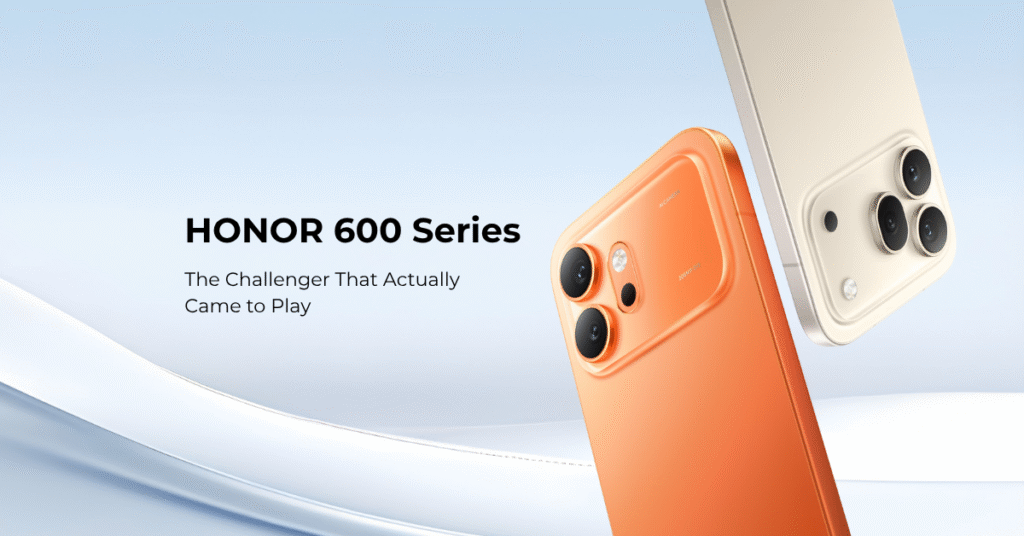
That architecture is under genuine pressure now, and the HONOR 600 Series is one of the clearest signals of why.
The South African creator economy has matured in ways that the global hardware market is only beginning to respond to. This is a market where content creation is not a niche behaviour confined to professionals with production budgets. It is mainstream, community-driven and increasingly export-ready. Weekly rituals like Bafana Bafana Friday generate the kind of organic, culturally specific trending energy that brand campaigns spend significant budgets trying to manufacture.
Local creators are building audiences that extend well beyond South Africa’s borders. The standard of what gets produced here, the visual quality, the storytelling sophistication, the platform fluency, has risen faster than the devices available at accessible price points were built to support.

What the market has been producing has consistently outpaced the capability of the tools it has been given to work with. That gap is exactly what is now being addressed, and the implications reach further than a single product launch.
The more interesting question is what happens to the creator economy when professional-grade AI imaging capability is no longer gated behind flagship pricing because that is the shift that is actually underway.
HONOR’s 600 Series brings an AI imaging engine that operates across the full arc of content production simultaneously, from real-time environmental reading at capture, through on-device computational photography that handles the kind of processing work that previously required either expensive hardware or a post-production workflow, through to a storytelling layer where the device actively participates in assembling and surfacing content.
The camera roll as raw material becomes the camera roll as edited output. The gap between capturing a moment and having something publishable closes to near zero. That is not a feature. That is a structural change in who can produce at what level.
For the influencer marketing industry, this has consequences worth thinking through carefully. Production quality has functioned as a natural filter in the creator economy, separating those with access to the right tools from those without. As that filter loosens, the differentiator shifts. It moves away from technical execution and toward creative perspective, cultural fluency and the kind of community trust that cannot be manufactured by better hardware.
Brands that have been using production value as a proxy for creator quality will need to recalibrate what they are actually measuring, because the baseline is rising across the board. The creator with a mid-premium device and genuine cultural relevance is increasingly a more valuable partner than the one with a flagship phone and a generic aesthetic.
The purchasing behaviour shift is already visible. A new generation of creators is making device decisions on functionality first rather than brand identity. They are asking what a device actually delivers for the specific work they are doing, the low-light captures at events that do not wait for good conditions, the reels that need to be ready before the moment passes, the long-form content that cannot afford a drop in quality halfway through. Brand loyalty built on prestige and cultural association is durable but not unbreakable, and when the functional gap between a premium brand and an ambitious challenger closes significantly, the emotional premium required to maintain that loyalty becomes harder to justify on a creator’s budget. HONOR’s arrival in this market at this price point is a direct response to that behavioural shift, and it is a well-timed one.
The on-device processing dimension of this conversation is one that the South African market in particular has reason to pay attention to. The global discourse around AI-powered consumer hardware has largely assumed strong and consistent connectivity as a baseline condition. It is not a baseline condition here. HONOR’s imaging stack processes locally, which means performance holds regardless of signal quality, whether that is at a family event in Soweto, on a road trip between cities, or at a venue where network congestion makes cloud-dependent features unreliable. For a creator whose content calendar does not pause for infrastructure limitations, that consistency is not marginal. It is foundational.
From a competitive positioning perspective, what HONOR has done with the 600 Series is precise enough to be instructive for marketers beyond the device category. Apple and Samsung have conditioned consumers to equate price with imaging quality so effectively that the association has largely gone unexamined. Google challenged it through computational photography and proved the argument could be won on merit in markets where it had distribution.
In South Africa, that distribution remains limited. The space was genuinely open, and HONOR has moved into it with a clear point of view rather than a broad capability claim. The #TurnMomentsIntoMotion positioning works because it is not about the camera. It is about the creator using it, specifically a creator who does not separate living from documenting, who produces and shares simultaneously, and for whom the distance between experience and published content needs to be as short as possible. That is a brief built on consumer intelligence, not product marketing, and the difference is detectable.

The broader lesson here is one that extends well beyond smartphones. The democratisation of serious creative tools is accelerating across every category, and the markets where that democratisation has the most cultural consequence are not the mature Western markets where the established players have deepest penetration.
They are markets like South Africa, where the creative output is already sophisticated, the creator community is already organised, and the only thing that has been missing is hardware that meets the standard the market has already set for itself.
The brands that understand this, that enter these markets with technology that is genuinely competitive and positioning that reflects an authentic read of local creative culture, will build the kind of consumer relationships that compound over time. The brands that wait for these markets to look like other markets before they take them seriously will find the relationships already formed when they arrive.
HONOR is not positioning itself as a challenger to Apple and Samsung in the traditional sense. It is positioning itself as the device that was built for a consumer the established players have consistently underserved. In South Africa, that consumer is not a niche segment. They are the market. And increasingly, they are the ones setting the standard that everyone else is trying to reach.
By Somila Gwayi