

The transition from dominant local player to a credible global player is often mischaracterised as a leap of faith, when in reality, it is a calculated series of operational pivots. For South African brands looking to scale beyond the continent, the traditional playbook suggests that global success necessitates a dilution of identity and of cultural specificities to appeal to a generic Western or Eastern consumer. However, while this may have been the case in the past, the current shift in trade mechanics reveals the opposite.
Today, cultural specificity, when paired with a sophisticated digital infrastructure and strategic distribution, has become a primary export advantage. This is most likely due to society’s insatiable desire to consistently consume goods and adopt new cultures to stay up to date with current trends. The brands currently winning on the global stage are those that have weaponised their local DNA, transforming their “African-ness” from a niche aesthetic into a high-value commercial differentiator globally.
Scaling a South African brand internationally requires more than just a superior product or service; it requires a sophisticated understanding of leveraging cultural uniqueness in different markets to generate a higher value product or service. To do so, one must identify what elements in one’s local market are underserved in a global context. Generally, a business’s progression into a global market is rarely a linear process. It takes defining where infrastructures, strategic partnerships and digital distribution converge to create a foothold in global markets.
Discovery is one of the most compelling examples of a company that didn’t merely scale a product, but rather, they scaled a systemic solution to a problem prevalent in almost every healthcare system globally, the problem being that global insurers are tethered to a model of high cost for reactive care. Discovery recognised an underserved gap in the market and responded with their proprietary “Vitality” system, a data-driven platform designed to encourage healthier living through behavioural economics. Their growth journey was far from linear. Rather than building consumer trust entirely from the ground up, they sought out partnerships with well-established international insurers such as AIA and John Hancock. Discovery integrated its “behavioural nudge engine” into the global insurers’ existing infrastructure and digital distribution networks, allowing them to transform a distinctly South African innovation into a vital intelligence layer for the global insurance industry. This experience not only accelerated their global expansion but also reinforced the value of collaboration and adaptability in scaling local ideas to a worldwide stage.
A key opportunity that companies can utilise, but should not rely on, in the transition from local to global is the use of diasporic networks. It is well-known that places like the UK, Australia, Canada, New Zealand, etc. have large South African communities. Rather than viewing these diasporic networks as consumer bases, these communities should be viewed as an opportunistic approach to be initial advocates and market entry facilitators for local brands aiming to make their global transition. As a result of this, a layer of trust and credibility will be acquired from the South African diaspora in the early stages of transition, in turn reducing customer acquisition costs in global markets by encouraging word-of-mouth advertising and allowing for further trust and credibility growth within the rest of the global market.
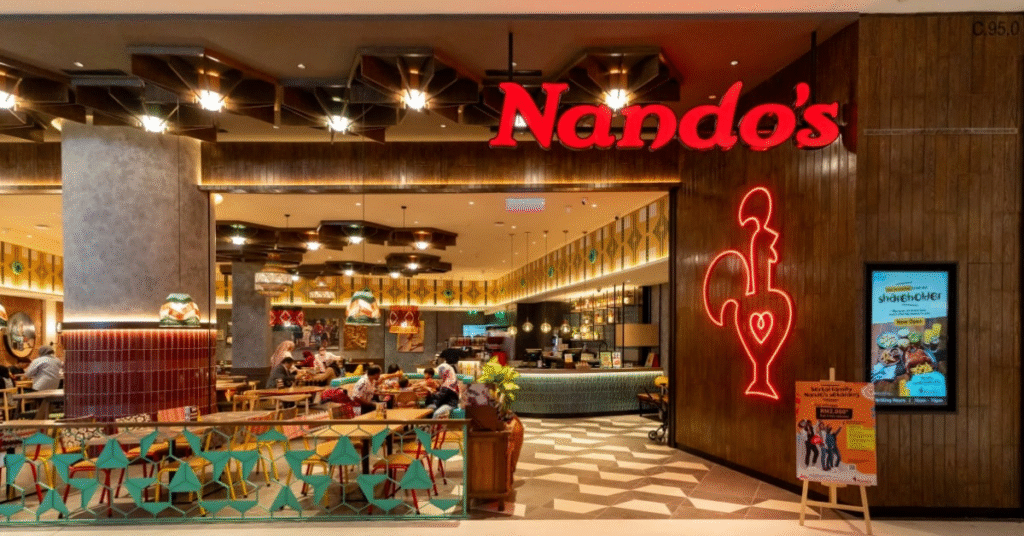
Nando’s serves as a definitive case study for this successful transition into a global market through weaponising their ‘South African-ness’ as well as through bringing a taste of home to the South African diaspora within the global context, no pun intended. Nando’s global trajectory was not built on the usual casual, fast dining model, but rather on their unwavering promotion of the Peri-Peri flavour, a flavour that is deeply rooted in South African history. Nando’s avoided homogenising their iconic flavours to fit the global markets; instead, they leaned into their ‘South-African-ness’ by being proactive and politically sharp in their marketing efforts, as well as by keeping their restaurants’ aesthetics to remain reflective of contemporary South African art.
Nando’s is not the only South African business to have a global transition success story. South African designer, Thebe Magugu also offers a blueprint of how cultural specificity can function as an export advantage. Magugu does not produce “African-inspired” clothing for a global audience; he produces deeply researched, high-concept fashion that uses South African history and sociology as its primary text. In doing so, this, along with his talents, enabled him to win the LVMH Prize in 2019, serving as a turning point in his career.
Thebe Magugu’s brand has always adopted the notion of a “digital-first, heritage-always” strategy. Magugu leveraged e-commerce platforms like 24S and Net-a-Porter to bypass traditional wholesale barriers and to maintain a strategic focus on small-batch, high-value production that consistently retains local craftsmanship while meeting high-quality standards of the global market. Instead of limiting his brand, these efforts, along with his unfaltering reliance on his cultural specificity, turned his brand into that of a luxury brand in the global market. Essentially, the mindset towards his brand became that of not merely purchasing a garment but rather acquiring a piece of authentic, Southern African narrative that global mass-market brands cannot replicate. His global successes ultimately led to his collaboration with the global phenomenon, Adidas.
The takeaway for South African founders is clear. Transitioning from local to global should not be an exercise of cultural dilution or erasure; it should be an uncompromising effort to maintain your cultural DNA. The world isn’t looking for diluted, generic copies of international goods. They are looking for authenticity, backed by the kind of digital and logistical rigour that proves you belong in their market. Ultimately, the goal is to shift from a mindset of “entering” a market to “staking a claim” in it. The global market is crowded, but it is also hungry for narratives that feel real, researched and undeniably distinct. South African brands have that authenticity in spades. The winners are those who realise that their roots are, in fact, their greatest reach.
By Callia Konidaris