

A quiet tension is shaping today’s creative landscape. Artificial intelligence is speeding up how work gets done, offering tools that can generate, refine, and iterate almost instantly. At the same time, there is a growing fear that this efficiency could flatten originality and dilute creative voice.
Yet, a more nuanced reality is emerging. Creators are not handing over authorship to AI. They are redefining how they work with it. Instead of replacement, AI is becoming a collaborator, one that expands creative possibilities while leaving authenticity intact. The difference lies in intention. Strong creative work is not determined by whether AI is used, but by how it is used.
Consider Thembelani Mkhize, a visual artist from Pietermaritzburg. His use of AI is not about novelty or trend-chasing. It is rooted in storytelling. By using AI to generate comic-style visuals, he explores social issues such as water shortages and load shedding, themes that are deeply embedded in everyday South African life.

What makes his work resonate is not the tool itself, but the perspective behind it. The humour, the critique, and the cultural nuance come from lived experience. AI simply helps him translate those ideas into visual form more efficiently. In this sense, the technology amplifies his voice rather than replacing it.
A similar approach can be seen in fashion. Designers Fikile Sokhulu and Nao Serati Mofammere have experimented with AI to bridge digital concepts and physical garments. In a collaboration with Volvo, they used AI to generate design concepts, which were then refined and translated into wearable pieces.
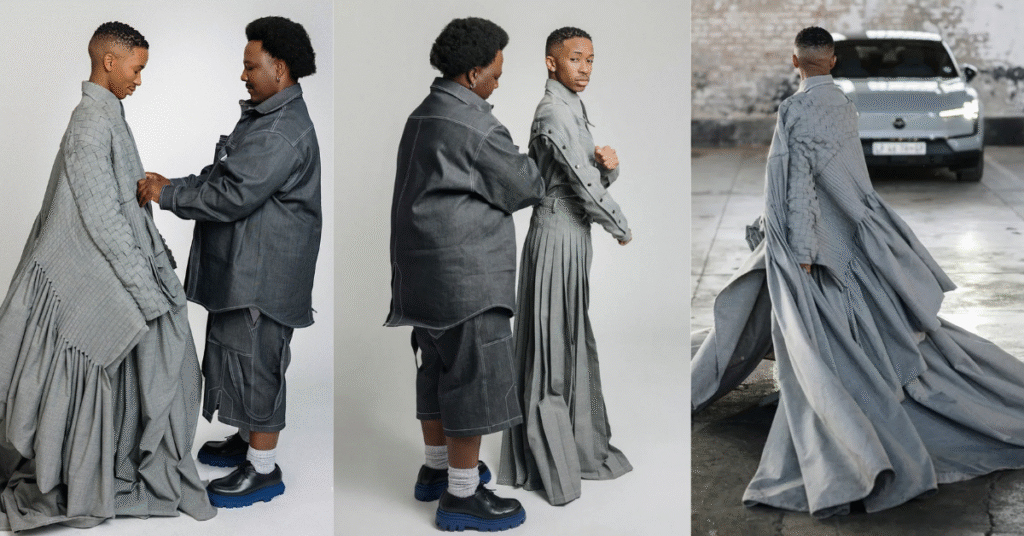
The final work did not feel artificial or detached. It carried a clear sense of authorship. The designers curated and interpreted the AI outputs, shaping them through their own aesthetic and cultural lens. This process of selection is crucial. AI can generate endless possibilities, but it cannot decide what matters. That responsibility still belongs to the creator.
Across these examples, one idea stands out. Authenticity is not lost when AI is used. It is lost when creators disengage from the process. Passive use of AI often leads to generic results, work that lacks depth, context, or identity. Active use, on the other hand, turns AI into a tool for exploration. It allows creators to push boundaries while staying grounded in their own voice.
This is especially important in contexts where storytelling is closely tied to culture and identity. In South Africa, creative work often reflects lived realities, histories, and communities. AI, when used thoughtfully, becomes a way to expand how these stories are told, not to replace them.
Of course, there are challenges. Questions around originality and over-reliance on AI are valid. There is a risk of work becoming homogenised, shaped more by algorithms than by individual perspective.
The answer, however, is not to reject AI. It is to use it with discernment. The most compelling creators treat AI as a starting point, not a finished product. They question outputs, refine them, and embed them within their own narratives. They understand that authenticity cannot be generated. It has to be maintained.
In the end, authenticity in the age of AI is about presence. It is about staying involved, making intentional choices, and ensuring that every piece of work still carries the imprint of the human behind it.
By Tshepang Ramokopelwa