
There was a time when the strength of an agency was measured by its size. The bigger the team, the broader the offering, the more credible the business. Scale signalled capability, and capability signalled dominance. That model no longer holds the same weight.
Across South Africa’s marketing landscape, a quieter shift has been taking place. It is not loud, and it is not always formally acknowledged, but it is visible in the work. Campaigns are no longer being built in isolation. They are being assembled through networks. Strategy comes from one place, creators from another, production from somewhere else, and yet, when it comes together, it feels cohesive.
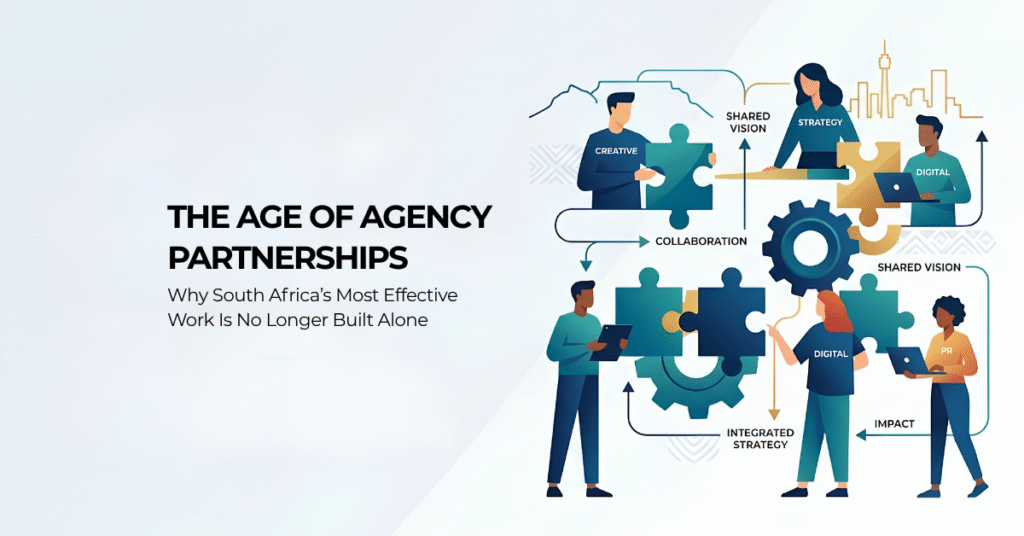
If you have worked on or observed any major campaign in the last year, you have likely seen this firsthand. The work does not sit neatly within a single agency’s walls. It moves across disciplines, across teams, business units and often, across entirely different businesses. This is not a coincidence. It is evolution. We are operating in the age of agency partnerships.
The reality is that the work has become too complex for any one entity to own in its entirety. A single campaign today must navigate strategy, culture, content, creators, distribution and real time audience response and reporting. It must exist across platforms, adapt quickly and remain relevant throughout its lifecycle. No matter how established an agency is, it is increasingly difficult to deliver all of that, at the highest level, alone.
What has emerged instead is a more connected way of working. Agencies are collaborating, not because they lack capability, but because collaboration produces better outcomes like more focused attention on the components of the work which creates a higher quality sum of the parts. The most interesting part is who is driving this shift.
It is not the largest agency. It is the more focused, often boutique players who have remained closer to the work. These are the teams that have built their reputations on specific strengths, whether that is cultural insight, influencer marketing, digital strategy or production excellence. Rather than diluting that strength in an attempt to offer everything, they have chosen to partner.
You see this in how influencer marketing agencies integrate into broader campaign ecosystems. A brand may lead with a traditional agency, but when it comes to creator strategy and execution, a specialist is brought in. That specialist works alongside the creative team, the media team and the client, contributing a layer of expertise that cannot be replicated through generalisation.

Agencies like HaveYouHeard have demonstrated the value of deep cultural understanding within youth and creator ecosystems, often collaborating with other partners to scale campaigns effectively. The Odd Number has built a reputation for culturally grounded creative thinking, which frequently exists within a broader network of execution partners. Even more established players such as Retroviral and Rogerwilco have shown that remaining competitive requires integration across disciplines rather than operating in silos.
If you step back and look at the work, the pattern becomes clear. The best campaigns are rarely the product of a single perspective. They are the result of aligned expertise. This is where many people have their moment of realisation.
Seamless collaboration does not happen by chance. It is built on clarity, alignment and trust from the outset. The most effective partnerships begin with a shared understanding of the outcome, not a negotiation of ownership, ensuring that every contributor is working towards the same goal rather than protecting individual territory.
Roles must be clearly defined early, with each partner understanding where they lead, where they support and how their work connects to others. This is reinforced by a single, cohesive narrative that guides all outputs, preventing fragmented execution.
Bringing partners in at the beginning of the process, rather than at the point of delivery, allows for more integrated thinking and more authentic outcomes, particularly within the creator economy. Finally, collaboration only works when there is trust in expertise and a clear decision-making structure that enables speed and accountability. When these elements are in place, multiple agencies can operate with the fluidity and precision of a single, unified team.
The creator economy, particularly in South Africa, moves quickly. It is shaped by culture, by conversation and by community. It requires an understanding that is both strategic and deeply human. That understanding does not sit in isolation. It sits in collaboration.
We work alongside agencies that bring different strengths to the table. Strategy partners, production teams, media specialists. Each plays a role in delivering work that feels complete without forcing any one party to overextend. Because that is the risk of the old model.

The moment an agency tries to be everything, it begins to lose the very thing that made it valuable in the first place. Its clarity. Its point of view. Its ability to see the nuance in the work.
Clients feel this shift immediately, even if they cannot always articulate it. The work becomes less sharp. The thinking becomes more generic. The connection to the audience weakens.
This is why trust has become the real differentiator. Not trust built on scale, but trust built on consistency, perspective and the ability to deliver within your lane while respecting the lanes of others.
It also explains why platforms like LinkedIn have become so important in this new landscape. It is no longer enough to list capabilities. Agencies and leaders are being evaluated on how they think, how they articulate their understanding of the market and how consistently they show up with clarity.
In the age of agency partnerships, selection is not just about who can do the work. It is about who understands it. That understanding is what enables alignment, and alignment is what makes partnerships work. The shift we are seeing is not a temporary trend. It is a structural change in how the industry operates. It reflects a broader truth that applies beyond marketing. Complex problems require connected solutions.
South Africa, in particular, is uniquely positioned for this model. The industry is diverse, the talent is specialised, and the proximity to culture is strong. When these elements are brought together intentionally, the output is not just effective. It is differentiated.
The opportunity now is to lean into this shift rather than resist it. To build partnerships that are deliberate, not reactive. To focus on strengths rather than trying to absorb everything. To recognise that collaboration is not a compromise of capability, but an amplification of it because the future of agencies in South Africa will not be defined by who is the biggest.
It will be defined by who is the most connected, the most intentional and the most trusted and in that future, the work will not be built alone. It will be built together.
By Somila Gwayi