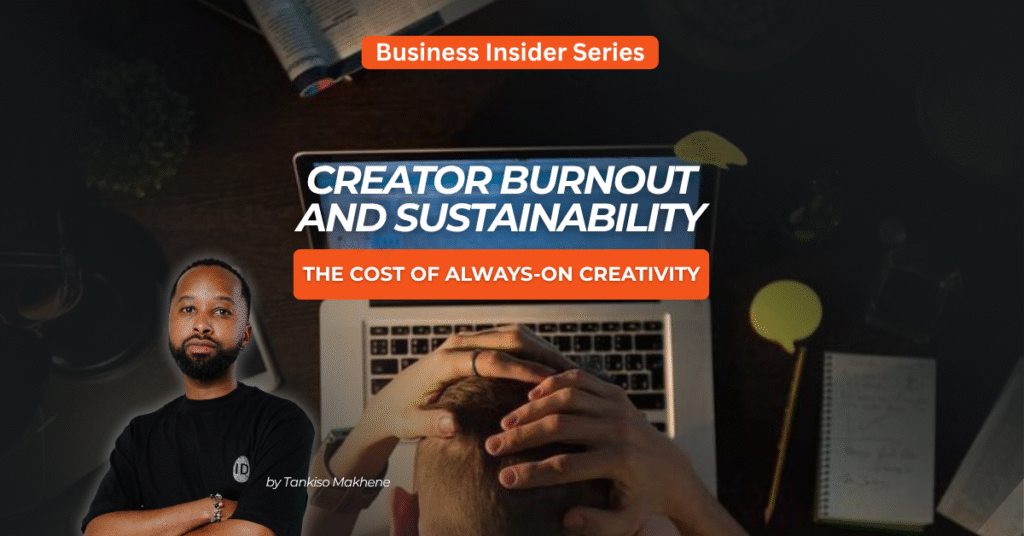
Content creation was once seen as a pastime. Something you did in between “real work”. The kind of thing your grandmother would politely tolerate before reminding you to go and get a proper job.
Fast forward a few years later, that same pastime has evolved into a full-time profession, one that sits at the centre of how brands communicate, how culture moves and how consumers make decisions. The creator economy has become one of the most powerful forces in modern marketing.
And yet, behind that growth, there’s a tension that’s becoming harder to ignore.
The creator economy has been built for scale, not sustainability,and in a world driven by endless doom scrolling, the appetite for content is infinite, but the people producing it are not.
For years, burnout was framed as an individual issue, “what do you mean you’re exhausted from taking videos on your phone?”, “Post less. Take a break. Protect your energy.” But that framing misses the reality of how this industry operates.
This is not a creator problem. It’s a system design problem.
Creators are not burning out because they lack discipline. They are burning out because the system demands unsustainable output , and, in many cases, it has quietly drained the fun out of the process.
Marketing has always evolved with the consumer. From the 4Ps to the 4Cs, and now to a landscape where audiences are more connected, more community-led and more demanding than ever. In this environment, creators are no longer a “nice-to-have”. They are central to how brands communicate, translate culture and drive relevance.
By 2025, creator marketing reached an inflection point. The funnel stopped being linear, and creator content began to scale far beyond what brands could produce themselves. Creators offer speed, flexibility and cultural proximity, and brands have responded by building entire strategies around that.
But here’s the shift we’re not fully acknowledging: we didn’t just integrate creators into marketing, we built the system around them.
What used to be once-off collaborations has evolved into always-on content ecosystems. Creators are no longer campaign amplifiers; they are extensions of brand teams. And while that’s commercially powerful, it comes with constant pressure to perform, stay visible and deliver measurable impact.
Then came the algorithm “gods”, quietly setting the rules. Visibility is no longer guaranteed , it’s earned continuously. Platforms reward recency, engagement and timing. Miss a moment and you disappear. Stay relevant and you’re locked into a cycle of continuous production.
The result is a system that pushes creators into behaving like real-time media channels rather than creative businesses. The line between identity and output starts to blur.
You’re not just creating content anymore — you are the content.
And audiences can feel it.
When creators are stretched too thin, the cracks show. Content becomes repetitive. Partnerships feel forced. Engagement starts to flatten. And what made creators valuable in the first place, you guessed it, the industry’s favourite buzzword, “authenticity”, begins to fade. At that point, burnout stops being invisible. It becomes commercial.
Creator fatigue is not just a wellbeing issue; it’s a business risk. If trust is the currency of the creator economy, then anything that erodes that trust directly impacts performance. Campaigns may deliver on paper but lack real cultural impact, often not a strategy issue, but a sustainability one.

Brands and agencies are not outside of this dynamic , they are actively reinforcing it, often without redesigning the systems creators are expected to operate in.
We’ve entered the age of distributed creativity, where creators influence what people watch, wear and buy. Naturally, brands want more, more content, more frequency, more relevance. But expectations are still built around volume, not longevity.
It’s a high-performance system running without the infrastructure to support it long term.
This is where the industry needs to shift.
Sustainability is not a wellness conversation. It’s a strategic advantage.
The creators who will succeed in 2026 are not necessarily the most visible. They are the ones building systems around their creativity. Moving from rented platforms to owned ecosystems. From chasing reach to building depth. From being just the talent to operating as a business.
Consistency is starting to outperform virality. Community is outperforming scale.
The real blind spot between global and African creators becomes clear here. African creators have been operating this way out of necessity. The ecosystem is growing, but infrastructure is still developing. Monetisation is less predictable, and many creators operate as one-person businesses.
But this has also made the market more adaptive.
African creators are deeply community-driven, culturally sharp and operationally agile while possessing a superpower that can’t be easily replicated: originality. In many ways, they are already modelling what sustainable influence could look like.
The African creator economy is not behind; it is simply operating without the safety nets other markets take for granted.
Which brings us back to the real question: are we building an ecosystem designed for viral moments or for durable careers?
Because if the current model continues, burnout won’t plateau. It will scale with the industry.
And until platforms, brands and agencies start investing in the infrastructure around creators ,not just the output ,sustainability will remain a talking point, not a reality.
by Tankiso Makhene