There are very few campaigns that begin with a truth so simple, yet so widely felt, that you immediately recognise yourself in it. Heineken’s Bar the Change campaign does exactly that.
For many South Africans, travelling abroad comes with a quiet but familiar tension. The excitement of being in a new city is often paired with the reality that your money does not stretch as far as it does at home. A drink that feels standard locally suddenly feels like a luxury. A casual night out requires calculation. Socialising, something that should feel effortless, becomes measured. It is not a dramatic problem, but it is a real one and that is precisely where the strength of this idea lies.
Heineken did not invent a new behaviour. It observed an existing one and asked a simple question. What if we could rebalance this experience? What if South Africans could carry a piece of home with them, not emotionally, but economically?
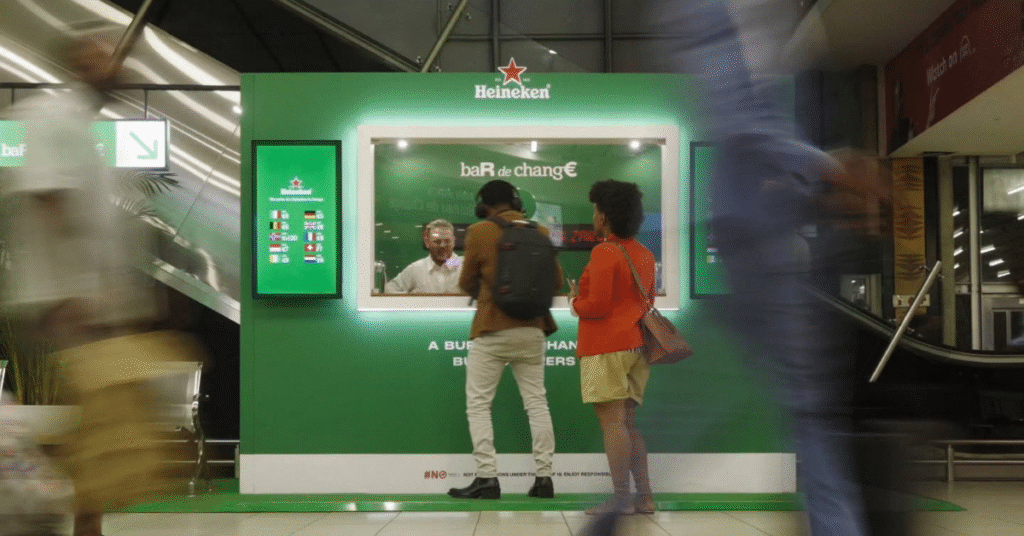
Bar the Change is the answer to that question. South Africans purchase their beers before they travel, at local prices, and redeem them at participating Heineken bars across Europe. In doing so, the disparity between currencies is temporarily removed, allowing consumers to experience global nightlife without the usual financial friction.
On the surface, it is a smart promotional mechanic. Beneath that, it is something far more powerful. It is a campaign rooted in empathy.
The brilliance of the idea lies in its understanding of the consumer. It recognises that travel is not just about movement. It is about participation. It is about feeling like you belong in a space, not like you are navigating it cautiously. By addressing the economic barrier to that participation, Heineken shifts the experience from one of limitation to one of inclusion and then it does something even more strategic. It places this solution in one of the most culturally charged global moments. Football.
The alignment with the global football calendar, particularly around major tournaments like the FIFA World Cup, is what elevates this campaign from clever to powerful. Football is not just a sport. It is community, ritual and social currency. It is where beer, culture and connection naturally converge.
For South Africans travelling abroad during this period, the stakes are even higher. Watching a match is not just about the game. It is about being in the bar, in the crowd, part of the energy. It is about belonging to that moment and when the cost of participation becomes a barrier, the experience is diminished. Bar the Change removes that barrier.
It allows South African fans to show up fully, without hesitation. To participate in global football culture without constantly calculating the cost of each round. In that context, the campaign does not just solve a financial problem. It restores access to a cultural experience. That is what makes it groundbreaking. This is where the campaign extends beyond the idea itself and into the creator economy.
Heineken did not rely on explanation. It relied on experience. South African influencers were flown to Berlin to test Bar the Change in real time, turning the concept into lived proof. The content that followed was not manufactured. It was reactive, immediate and grounded in genuine experience.
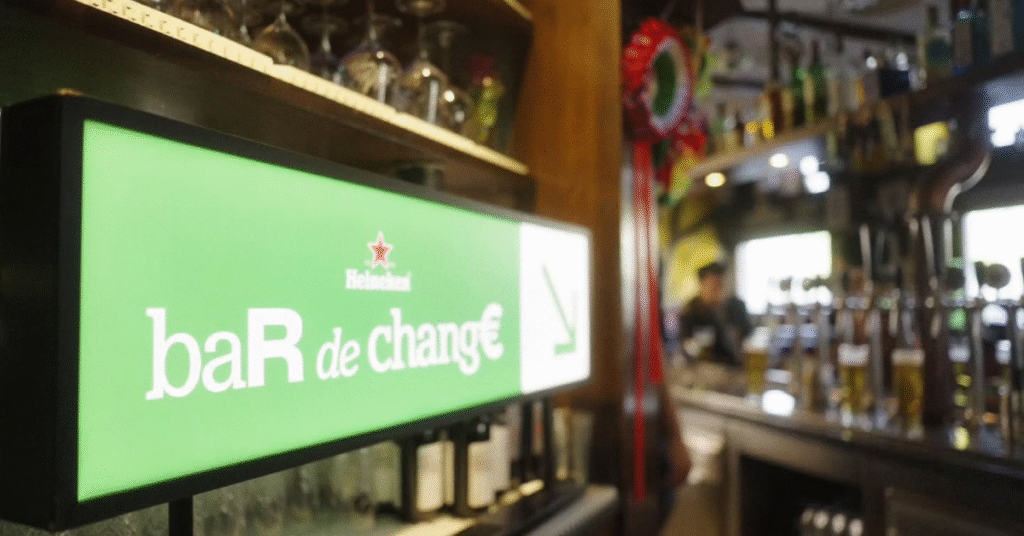
Creators described the campaign as having “raised the bar,” while others noted that “Terminal A just got a whole lot better.” These moments matter because they are not scripted. They are reflections of a shift that can be felt and that is what audiences respond to.
In the creator economy, credibility is built through experience, not messaging. When influencers document something that directly improves their reality, it resonates more deeply. It moves beyond promotion and into validation.
What Heineken has done here is create a campaign that creators can naturally integrate into their own narratives. Travel, lifestyle, cost of living, access. These are all themes that already exist in their content. Bar the Change simply enhances them. This is what strong creator-led campaigns look like. They do not interrupt. They fit.
From a social impact perspective, the campaign operates on multiple levels. It provides practical relief, allowing South Africans to stretch their spending while abroad. It offers emotional ease, reducing the friction that often comes with navigating foreign environments. And it reinforces a sense of belonging in spaces where economic differences can otherwise be felt. At the same time, it acknowledges a broader national reality.
The strength of the rand has long shaped how South Africans experience the world. Instead of ignoring this or framing it negatively, Heineken addresses it directly, using creativity to create a moment where that limitation feels less significant. That is what makes the work culturally intelligent.
From a creative standpoint, this is exactly the kind of idea that wins globally. It is simple, rooted in truth and executed in a way that feels both scalable and human. It does not rely on spectacle. It relies on relevance and relevance travels.
For the South African creative industry, this is a clear signal. Our insights are not niche. They are powerful. When translated correctly, they resonate on a global stage without needing to be diluted. Bar the Change proves that.
Ultimately, the power of this campaign lies in its timing, its truth and its execution. It meets consumers at the intersection of travel, culture and economy, then amplifies that moment through creators who bring it to life. It does not try to solve everything. It solves one thing, exceptionally well and in doing so, it reminds us that the most impactful work is not just seen. It is felt.
Bar the Change is not just a campaign. It is access, reimagined and that is what makes it powerful.
By Somila Gwayi