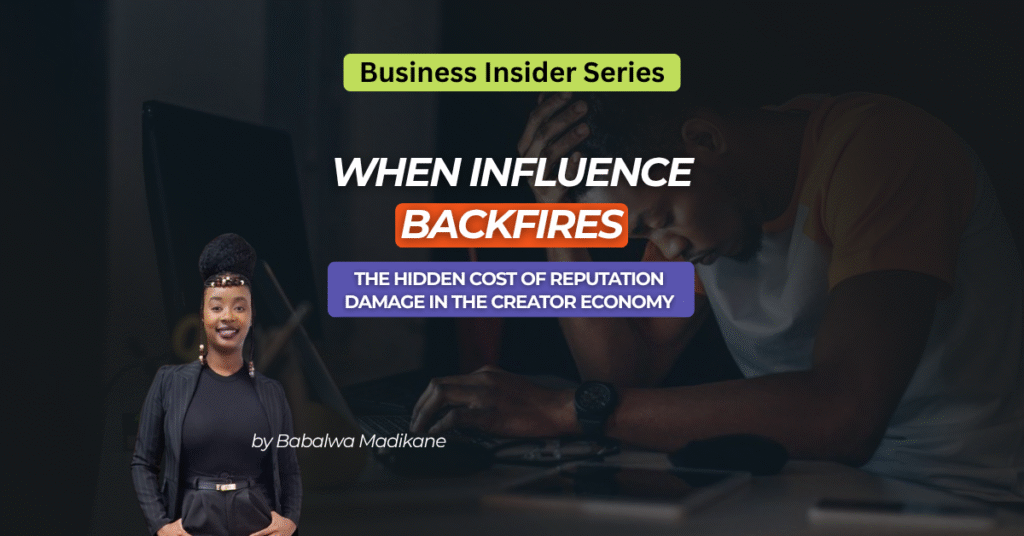
Influencer marketing has become one of the most powerful tools in modern brand building, sitting at the intersection of culture, commerce, and community. However, as influence grows, so does risk. The same visibility that makes influencers valuable can also make them vulnerable, and when something goes wrong, the consequences rarely stay contained. Instead, they ripple outward, affecting brands, agencies, audiences, and even broader societal narratives. In today’s landscape, influence is no longer just about reach, it is about responsibility, credibility, and alignment.
Recent developments around the Madlanga Commission in South Africa highlight just how deeply influence can intersect with reputational risk. The Commission has been investigating allegations of corruption, fraud, and systemic misconduct within the justice system, revealing how financial networks can extend beyond politics and business into lifestyle ecosystems (The Citizen, 2025). In cases where individuals linked to alleged misconduct have funded or supported visible lifestyles, the impact does not remain isolated. Influencers connected to these networks, whether directly or indirectly, find themselves implicated in the narrative, with their credibility questioned and their platforms scrutinised. Even adjacent figures such as family members are affected as public perception begins to shift. What was once aspirational quickly becomes questionable, and the line between influence and accountability becomes blurred.

Outside of high-profile investigations, influencer brand damage often stems from more familiar but equally impactful issues. A lack of transparency around paid partnerships, misalignment with brand values, association with controversial figures, or inflated engagement through artificial means can all erode trust. Research shows that influencer fraud and fake engagement practices continue to undermine credibility across digital platforms, reducing audience trust and campaign effectiveness (Kumar et al., 2024). In an environment where audiences are increasingly aware and critical, authenticity is not just a value, it is a requirement. When that authenticity is compromised, the fallout is immediate and often irreversible. Influencers who fail to disclose partnerships or comply with advertising standards risk losing both audience trust and brand relationships (Evans et al., 2017).
For the influencer, the impact is both reputational and financial. Influencers today operate as businesses, whether formally structured or not, and their credibility is directly tied to their earning potential. When trust declines, so does their ability to secure partnerships, maintain audience engagement, and grow sustainably. In more serious cases, financial scrutiny may follow, with organisations like SARS increasing their focus on undeclared income, sponsorship earnings, and discrepancies between lifestyle and reported revenue. The South African Revenue Service has repeatedly highlighted the need for digital earners to declare income accurately, reinforcing that influencer activity is subject to the same tax obligations as any other business (SARS, 2023). What may begin as a reputational issue can quickly evolve into a broader financial and legal challenge.
For brands, the risk lies in association. Influencer partnerships are built on alignment, and when that alignment is disrupted, the brand often bears the consequences alongside the influencer. Campaigns may need to be paused or withdrawn, investments lost and public perception managed in real time. Studies have shown that negative influencer behaviour can directly impact brand perception and consumer trust, particularly when audiences perceive a lack of due diligence in partnerships (Lou and Yuan, 2019). In some cases, brands are forced to publicly distance themselves, which can undermine both the campaign and long-term audience relationships. The challenge is not just about avoiding controversy, but about ensuring that every touchpoint consistently reflects the brand’s identity and values.
Agencies sit at the centre of this dynamic, carrying both responsibility and risk. They are tasked with identifying the right talent, aligning creators with brand strategy, and ensuring that campaigns deliver both creatively and commercially. When influencer brand damage occurs, agencies are often held accountable for gaps in vetting, oversight or strategic alignment. This has led to the development of more structured governance models within agencies, including behavioural clauses, compliance frameworks, and crisis management protocols. Increasingly, agencies are not just managing campaigns, they are building systems that ensure influencers operate as credible and compliant business entities.

This shift has contributed to the rise of what can be described as creator engines, structured ecosystems designed to support influencer growth while maintaining alignment with brand strategy. Think of how Red Bull operates, not as a brand that sponsors creators, but as a media company that builds them. Creators are embedded into the brand’s world, given resources, creative freedom and distribution, and in return they produce content that feels native to their audience while staying unmistakably Red Bull. A creator engine is not a campaign – it is infrastructure. One brand, one brief, ten creators, ten authentic stories, one consistent direction. These systems help influencers think beyond individual campaigns and instead operate as long-term brand entities. However, many creators still overlook the fine print in contracts, misunderstand the expectations within briefs, or fail to consider the long-term implications of their actions. This lack of structure creates friction within campaigns and increases risk for both brands and agencies.
The industry is therefore moving away from viewing influencers purely as personalities and toward recognising them as structured business entities. This requires a higher level of discipline, governance, and strategic thinking. Influence is no longer just about visibility, it is about consistency, accountability and the ability to operate within a defined framework that protects all stakeholders involved.
At Style ID Africa, this is exactly the space we operate in. We understand that influencer marketing is not just about scaling reach, but about building systems that protect and strengthen brand identity over time. Our approach focuses on developing carefully considered influencer growth engines, where creators are aligned with brand values, supported by clear policies, and guided by strategic frameworks that ensure consistency across every touchpoint. By putting these structures in place, we help brands and agencies mitigate risk while enabling creators to grow in a way that is both sustainable and credible.
In a landscape where a single misstep can have far-reaching consequences, the future of influencer marketing belongs to those who treat influence not as a moment, but as a managed and strategic asset.
by Babalwa Madikane